

Stuck At The Top
Are thrill rides too risky?

At 5:21 on Thursday night, the Iron Shark roller coaster at Galveston’s Pleasure Pier stopped climbing. It just… stopped, pointing straight into the sky, 100 feet over the Gulf, with eight middle and high school students strapped into a car that was now frozen at a vertical pitch. They were on a field trip with a STEM academy out of Houston. A passerby caught it on video; you can hear someone off-camera say, “Oh my god. Holy hell.”
The fire department brought in a ladder truck with an aerial platform, harnessed each kid one at a time, and walked them down the ride's steep steel skeleton into a rescue basket. It took almost four hours. The last student came down a little after 9 p.m. The fire chief said the riders were checked mainly for dehydration — they’d been stuck in the sun a long time.
Thankfully, none of them were injured.
Watch the ABC7/KTRK footage of the Iron Shark rescue here:
https://abc7.com/post/galveston-texas-roller-coaster-stopped-rescue-underway-riders-stranded-upside-down/19189772/
The footage is genuinely frightening. But the result was a group of teenagers who were bored, maybe sunburned, and probably never going on that ride again, but completely fine. What’s lost on social media is that the contrast between how dangerous it looked and how dangerous it actually was is enormous. But I feel like I’m seeing more and more videos of carnival and theme park rides breaking down or failing entirely.
So let me ask this: Are thrill rides still safe to ride?
Are thrill ride accidents more common today?
Maybe you’ve seen the videos — the carnival ride that buckles, the coaster stalled upside down, the drop tower that won’t drop. I’ve seen them too. They’re seemingly everywhere. I’d be lying if I said it didn’t affect my decision to refrain from riding certain rides with my adventurous son at our local fair.
We know why videos of those events permeate social media platforms. It’s clickbait. Millions of people spun around and step off smiling without incident? Not much to see there. Nobody has ever opened TikTok to a clip captioned “Local Man Rides Tilt-A-Whirl, Experiences Mild Joy, Gets Funnel Cake.” Researchers who study this have a name for the distortion: thrill ride accidents get inherently amplified, because news coverage favors the dramatic and the unusual. One analysis found that roughly 19% of media-reported ride accidents involved a fatality — while in actual government injury data, fatalities occur at a rate of one per 2,000 to 3,000 injuries. The feed isn’t lying to you, exactly. It’s just showing you the 0.04% without the context of the other 99.96%.
The algorithm rewards “Holy hell.”
Putting Your Mind at Ease
Here’s the part that surprised me when I dug in.
The industry’s headline number, produced annually for the trade association IAAPA by the National Safety Council, is this: the chance of being seriously injured on a fixed-site ride at a U.S. amusement park is about 1 in 15.5 million rides taken. For scale, somewhere around 385 million people take roughly 1.7 billion rides at North American parks in a typical year.
The rest of the numbers point the same direction. In a recent year the survey estimated about 1,390 ride injuries total, with under a fifth classified as serious — and the share of serious injuries has been falling, dropping 54% in a single recent year to around 8% of all injuries. Overall ride injuries are down about 29% since 2003. Deaths tied to amusement rides run fewer than five a year in the U.S. — a number that’s stayed low and stable for decades against a backdrop of hundreds of millions of riders.
Roller coasters specifically carry the highest injury rate of any ride type — and even that comes out to roughly 1.3 injuries per million rides. You are vastly more likely to be hurt driving to the park than on anything inside it.
Things that will kill you first
Hold “fewer than five deaths a year” in your head. In a typical year in America:
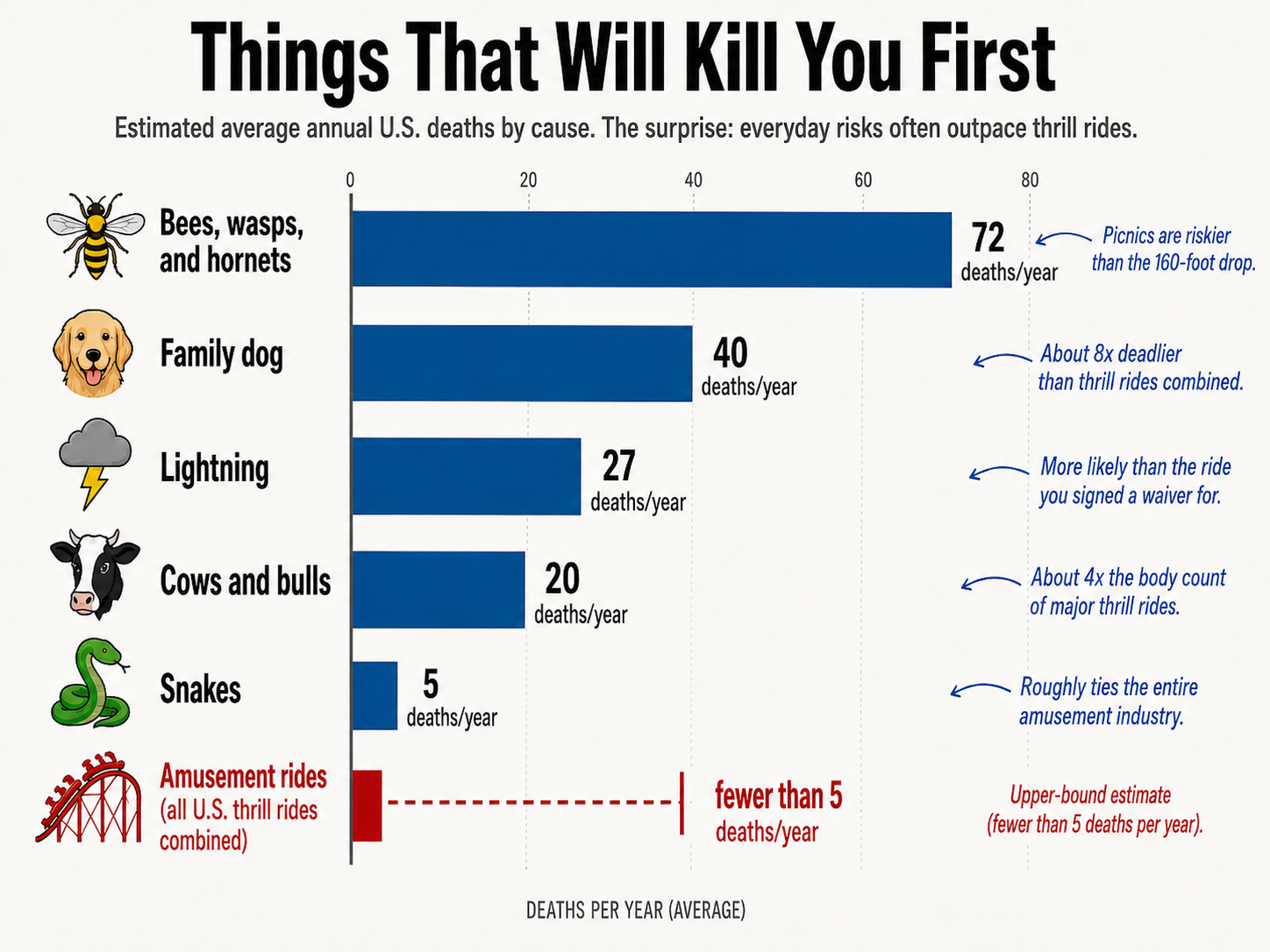
So the scoreboard reads: a beehive, the family doodle, a summer thunderstorm, and a herd of cows each out-kill every roller coaster in America, and the high-speed contraption engineered from to elicit screams loses, annually, to a malfunctioning Coke machine.
One bit of fairness before you screenshot that for your group chat: these are raw death counts, not exposure-adjusted rates. Vastly more people pet dogs and stroll past vending machines than strap into inverting steel coasters, so it’s not a clean apples-to-apples risk comparison. But as a gut check on where your fear is actually warranted, it’s bracingly clear — the universe has a lot of more mundane ways to get you, and it deploys them far more often than the Iron Shark ever will.
So if you want the short, strong answer: yes, statistically, modern thrill rides are remarkably safe. Getting stuck at the top, like those kids in Galveston, is overwhelmingly the most “dangerous” thing that will happen to you, and getting stuck is — this matters — the safety system doing its job. Rides are engineered to halt when a sensor reads something it doesn’t like. A stall is the fail-safe triggering. In this case, the ride is functioning, or at least its safety systems.
I could stop there. Ride enthusiasts like my son would like me to stop there. But this is Comfortably Uncertain, so here come the caveats.
Caveat One: We’re partly grading the industry by its own research
That beautiful 1-in-15.5-million figure isn’t from a regulator. It comes from a voluntary survey the industry runs on its own. In a given year, only around 180 to 210 facilities — out of roughly 440 operating parks — actually respond, representing maybe 60-64% of attendance. The data is real, and the methodology is sound, but it’s self-reported, partial, and assembled by the people with the most to lose from poor results.
It wouldn’t bother me if this were the only caveat. It isn’t.
Caveat Two: the “roller coaster loophole.”
The Consumer Product Safety Commission — the federal agency that recalls dangerous toys and appliances — has no authority over the permanent rides at your big theme park. In 1981, a budget bill stripped the CPSC of jurisdiction over “fixed-site” amusement rides, an exemption critics have spent forty years calling the roller coaster loophole. Fixed-site rides were, for a long stretch, the only product category exempted from CPSC regulation and not picked up by any other federal agency. There is still no national requirement that a theme park report a ride malfunction or fatality to anyone federal, and no central clearinghouse so that a defect found on one ride in one state triggers a fix on identical rides everywhere else.
The result is a 50-state free-for-all. Currently, 44 of 50 states regulate fixed-site parks, leaving Alabama, Mississippi, Montana, Nevada, Wyoming, and Utah essentially without oversight. Massachusetts Senator Ed Markey has introduced bills to close the loophole repeatedly since the 2000s; none have passed. The industry argues a federal agency couldn’t outperform the existing system. That may be true. But “trust us, our private survey says it’s fine” is a weaker foundation for confidence than the safety record itself deserves.
So where does this leave us? I’m comfortably uncertain rides are very safe, and our certainty is lower than it could be because no one is required to report to a regulatory authority when something does go wrong.
What about carnival rides?
Now, it almost goes without saying that the robust permanent coaster at a major theme park is a completely different animal from the ride that shows up in a county fair parking lot last night, gets bolted together, and is torn down every week.
The mobile carnival rides are the ones the CPSC actually does cover. But coverage does not include inspection. And, with up to 3000 fairs in the US annually, the agency doesn’t have the manpower to check every fair. Portable rides face stresses permanent ones don’t: constant assembly and disassembly, different conditions at each stop (on concrete, asphalt, muddy grass?), decades-old equipment trucked from town to town, and difficult-to-identify metal fatigue.
Which brings us to the Ohio State Fair, July 2017. A swinging, spinning ride called the Fire Ball was running when one of its arms snapped mid-flight, throwing four riders to the pavement 20 feet below. Tyler Jarrell, an 18-year-old who’d just enlisted in the Marines, was killed; seven others were hurt. The cause, per the Dutch manufacturer’s metallurgical investigation: excessive corrosion on the interior of a support beam, which had quietly thinned the steel wall of the beam over the ride’s 18-year life. The chilling part is that the Fire Ball had passed inspection three or four times in the days leading up to the incident, with passing marks on dozens of items, including possible cracks and proper assembly. The inspection sheet wasn’t designed to reveal this kind of problem.
So how do they compare to fixed rides? The big theme park coaster has a better case for safety. The carnival ride is still statistically safe, but it lives closer to the edge of the system: less permanent infrastructure, more movement, more assembly, more wear, less clean data, and inadequate oversight.
The scariest failures aren’t structural. They’re bad decisions.
If you actually trace the rare catastrophic incidents, a pattern emerges that’s more unsettling than “rides are dangerous.” It’s that the deadliest failures usually aren’t random — they’re human.
In March 2022, 14-year-old Tyre Sampson fell to his death from the Orlando FreeFall drop tower at ICON Park — a fixed-site ride. A maintenance technician later alleged in a whistleblower suit that the seat sensors had been manually modified to accommodate riders outside the safe height and weight limits, that overheated cylinders kept seats from securing properly, and that crews weren’t trained on maintenance or patron safety. Tyre was above the ride’s weight limit. The restraint didn’t hold him. The failure wasn’t a freak act of physics — it was a chain of choices to override the safety envelope the ride was designed around. Florida later passed the Tyre Sampson Act tightening ride rules.
This is the genuinely ugly part, and it’s where my skepticism actually lives. Not in the engineering — the engineering is extraordinary. It’s in the gap between the ride as designed and the ride as operated and maintained on a hot afternoon by an underpaid crew running behind schedule. Aging equipment, hidden corrosion, sensors fudged to keep the line moving — those are the threads that run through the rare tragedies, and none of them show up in a glossy “1 in 15.5 million” headline.
Both sides are playing with numbers
Both sides of the safety issue play the same game, and you should know the move when you see it.
The industry says “1 in 15.5 million rides” — true, but it’s their survey, and “per ride” is a flattering denominator when each person takes a dozen rides a day. Years ago, Senator Markey argued from the other direction that coaster fatalities per passenger mile exceed those of trains, buses, and planes. While technically defensible, it’s also nonsense, because “passenger mile” is a unit built for transportation, while a roller coaster is a 90-second emotional experience that happens to travel a short distance very fast. Same underlying reality, opposite spin, depending on which fraction someone wants to use to sway you.
When you strip the framing away, the middle is where the truth sits: per ride, per visit, per summer, the odds of getting hurt are genuinely tiny. Which is, admittedly, a terrible chant to start in line. “WHAT DO WE WANT? Statistically insignificant risk! WHEN DO WE WANT IT? Within one standard deviation of the mean!” Nobody’s printing that on a T-shirt. But it’s the truth.
Where I land
Bottom line: yes, they’re safe. And, yes, I’m still wary of carnival rides. If you watched a video of people stranded on a coaster this week and felt your stomach drop, the most likely ending to that story, by a wide, wide margin, is exactly what happened in Galveston: a long, uncomfortable wait, a ladder truck, and everyone walking away. The terror is real; the danger usually isn’t. And the thing that scared you, the ride stopping dead, is not the machine betraying its passengers, but protecting them.
The ride itself is almost certainly fine. What’s worth your attention is everything around it. A parent can’t fully inspect the engineering of a carnival ride, but you can judge the warning signs around it: watch one full cycle, look for rough movement, strange noises, visible rust, loose parts, sketchy supports, or distracted operators. Make sure the ride has posted rules, that your child clearly meets the height and restraint requirements, and that the operator physically checks every lap bar, belt, or harness before starting. If the setup looks chaotic, the crew seems careless, the ride looks worn out, or your gut says something is off, skip it. The safest rule is simple: clean setup, serious operators, clear rules, snug restraints, green light; sloppy crew, tired equipment, bad fit, walk away.